
When Is the Best Time to Take a Men's Multivitamin?
By AT2AUpdated 6 min read

About 28% of American men take a multivitamin/mineral supplement, rising to 40.9% of men aged 71 and older, according to national survey data summarized by the NIH Office of Dietary Supplements1. Most people never think about when to take it. Timing will not turn a multivitamin into something it is not, but it does affect how comfortable it feels and how well a few nutrients are absorbed.
This guide answers the timing questions men ask most often, shows what the evidence says about each, and explains how to read your label so the routine is safe.
What is the best time of day to take a men's multivitamin?
The honest answer: the best time is with a meal you eat every day. The NIH fact sheets give clear guidance about food, not about the clock. Three nutrients found in most men's formulas explain why:
- Vitamin D is fat-soluble. Fat in the gut enhances its absorption, although some is absorbed without fat2. The same applies to vitamins A, E and K.
- Folic acid is better absorbed with food. At least 85% of folic acid is estimated to be bioavailable when taken with food; the official conversion treats folic acid on an empty stomach differently from folic acid taken with meals5.
- Minerals can upset an empty stomach. Taking iron supplements with food can help minimize stomach effects such as nausea and constipation3, and absorption of calcium supplements is generally greater with food4.
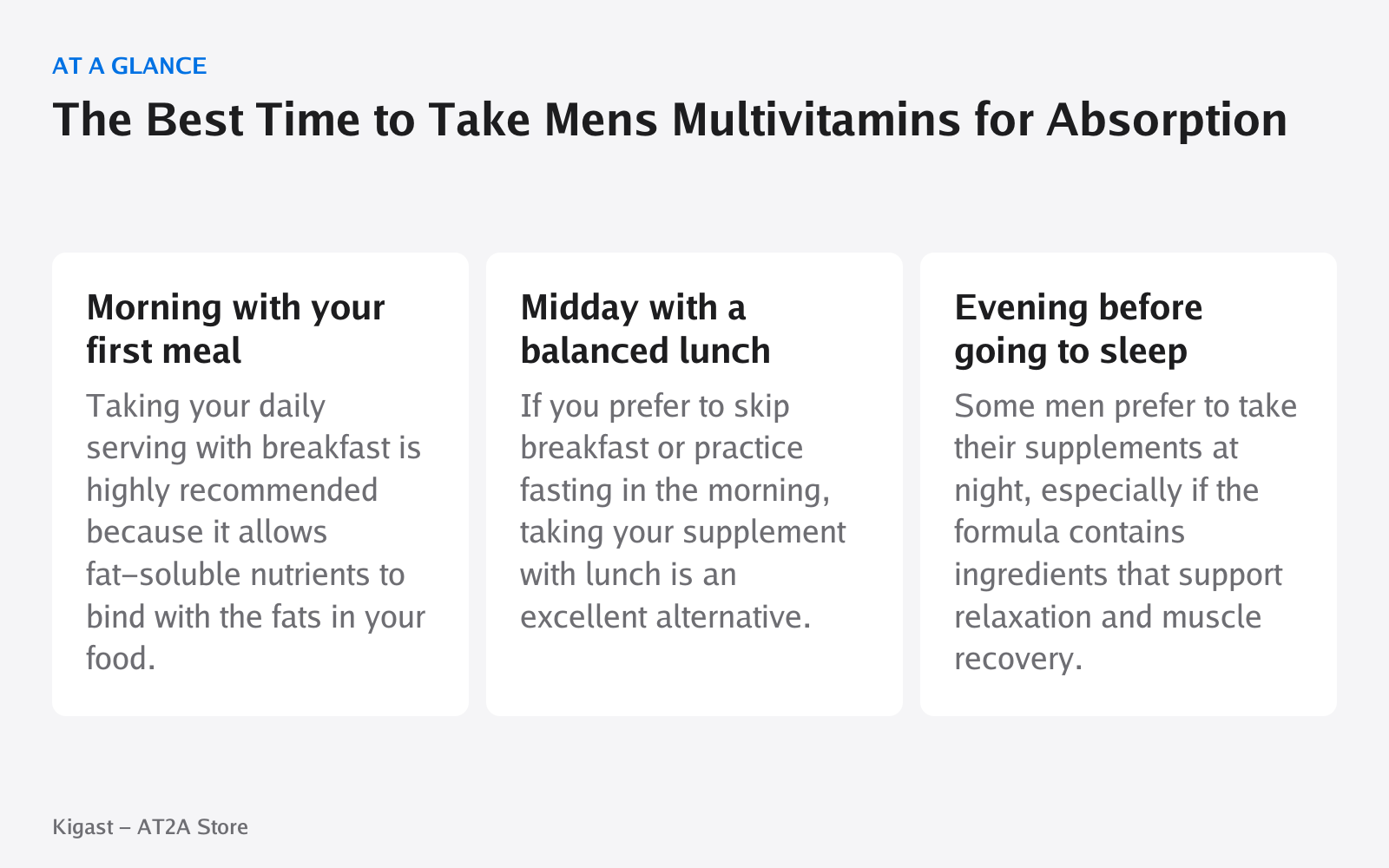
Morning with your first meal
Breakfast works well if it contains some fat (eggs, yogurt, nut butter, milk). It also ties the habit to something you already do every day, which is the biggest factor in actually taking it.
Midday with lunch
If you skip breakfast or eat very little in the morning, lunch is a better anchor. A full meal gives fat-soluble vitamins something to travel with and buffers the minerals.
Evening with dinner
Dinner is fine for a plain multivitamin. If your formula also contains herbs or ingredients you take for daytime energy, keep it earlier in the day so it does not get in the way of winding down.
Plan your timing with the AT2A supplement timing tool: men's multivitamin and vitamin D3.
What does the evidence say about multivitamin timing?
| Question | What the NIH fact sheets say | Strength of evidence |
|---|---|---|
| Take with food or on an empty stomach? | Fat improves vitamin D absorption2; folic acid is at least 85% bioavailable with food5; food eases iron side effects3. | Consistent: several nutrients point the same way |
| Morning or night? | No fact sheet names a best hour for a multivitamin. | No direct evidence either way |
| Take calcium in one dose or split it? | Absorption is highest at 500 mg or less at a time; about 36% of a 300 mg dose is absorbed versus 28% of a 1,000 mg dose4. | Measured absorption data |
| Take iron and calcium together? | Calcium might reduce iron absorption, though the effect is not definitively established; experts suggest taking separate calcium and iron supplements at different times of day3. | Possible effect, precautionary advice |
Should you take a multivitamin on an empty stomach?
It is usually better not to. Concentrated minerals are the common cause of nausea when a multivitamin is swallowed with only water, and the fat-soluble vitamins lose the dietary fat that helps them absorb. If a meal is not possible, a small snack that contains some fat is better than nothing.
What is actually inside a men's multivitamin?
Most basic multivitamin/mineral products contain all or most vitamins and minerals in amounts that do not exceed the Daily Values, and formulas for men typically provide different amounts of the same nutrients than formulas for women1. Many men's and senior formulas contain less iron or none at all3. Some products add herbs or amino acids, which have their own timing considerations.
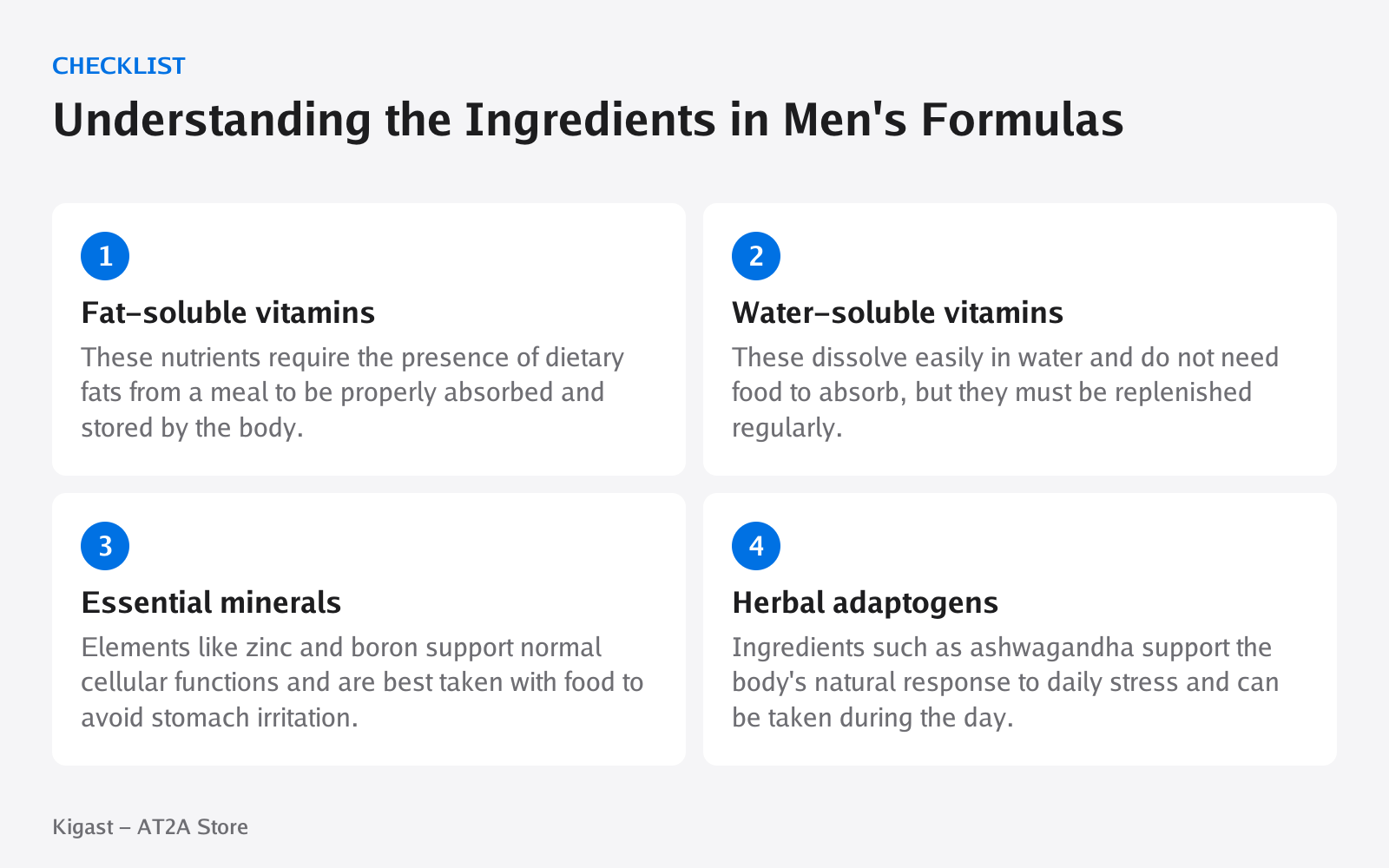
- Fat-soluble vitamins (A, D, E, K): absorbed with dietary fat, so take them with a meal.
- Water-soluble vitamins (B vitamins, C): dissolve in water and are not stored in large amounts, so a daily routine matters more than the hour.
- Minerals (zinc, magnesium, iron): gentler on the stomach with food. The adult upper limit for zinc from all sources is 40 mg a day6.
- Herbs such as ashwagandha: follow the directions on the label and ask your pharmacist about interactions.
Do gummies, capsules or liquids change the timing?
The form changes convenience more than timing. Take any form with a meal unless its label says otherwise, and compare the per-serving amounts in the Supplement Facts panel rather than the front of the pack.
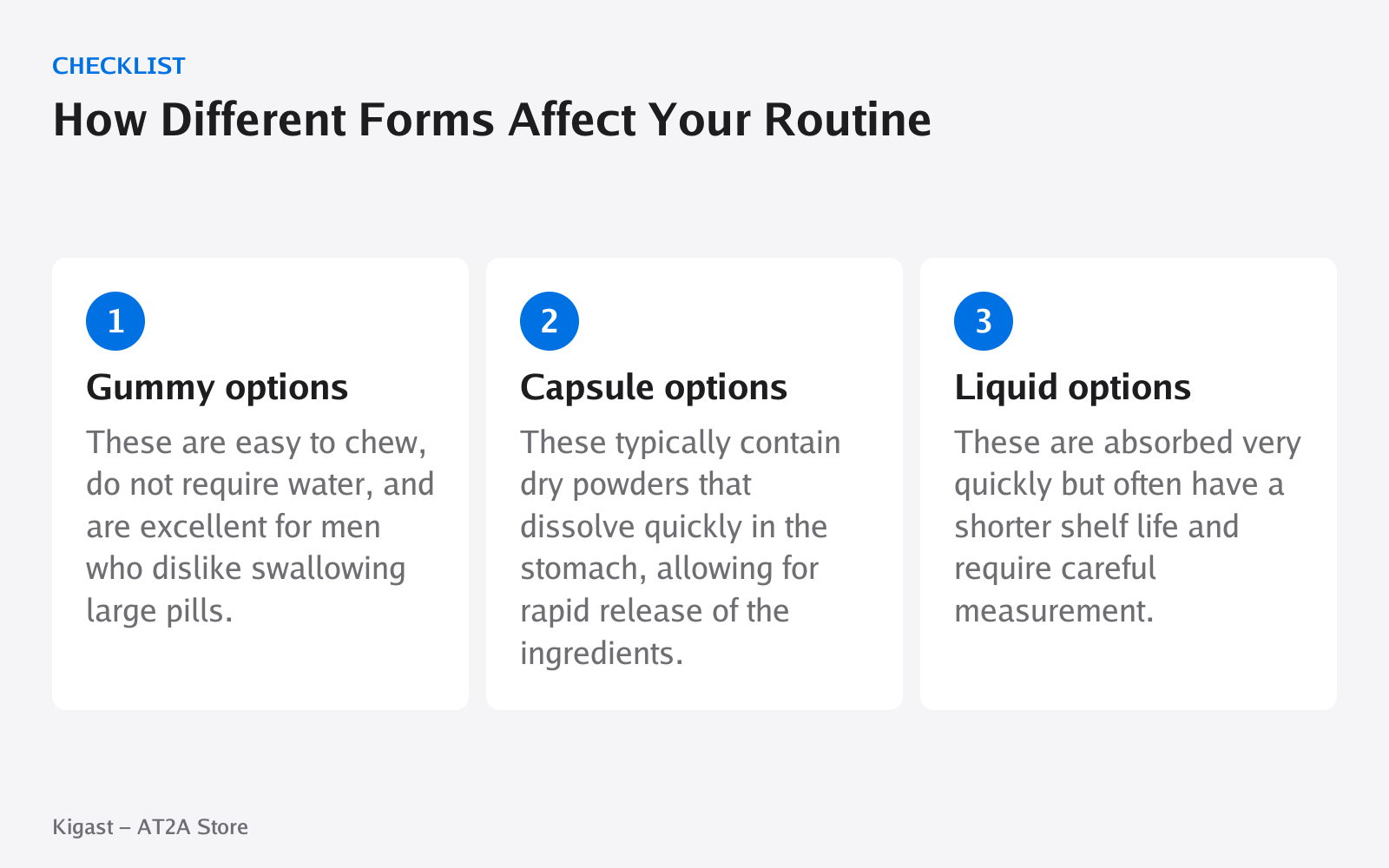
- Gummies: easy to chew without water, but often contain sugar and may hold less of an ingredient per piece.
- Capsules and tablets: usually hold more per serving; swallow with water and food.
- Liquids: measure carefully with the dropper or cup that comes with the product.
Two AT2A options take different approaches. ORANIC EXTRACT 3-in-1 Wellness Gummies combine shilajit, sea moss and ashwagandha, with 30 gummies per container, are labeled third-party lab tested, and use manuka honey as a sweetener. They are a botanical gummy, not a vitamin-and-mineral multivitamin.

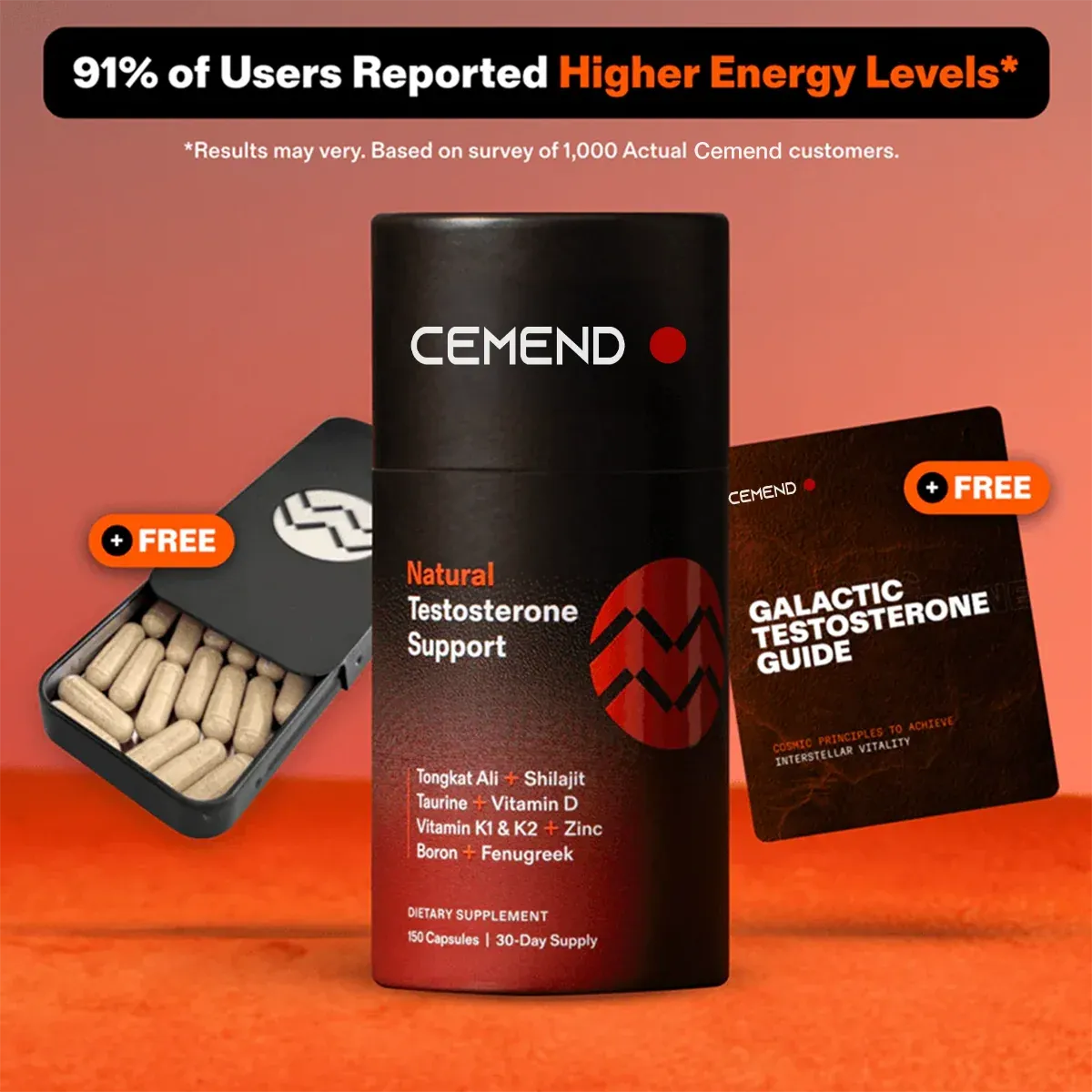
CEMEND Natural Testosterone Support is a capsule formula: 150 capsules, a 30-day supply. Its label lists tongkat ali, shilajit, taurine, vitamin D, vitamins K1 and K2, zinc, boron and fenugreek. The front label does not show amounts per serving, so check the Supplement Facts panel before combining it with a multivitamin that also contains zinc or vitamin D.
How do you read a supplement label so you do not take too much?
- Find the serving size. Every amount on the Supplement Facts panel refers to one serving, which may be more than one capsule or gummy.
- Check the directions. Many labels say "take with a meal". Follow the label over any general guide, including this one.
- Add up overlapping nutrients. Excess intake usually comes from stacking products. In one large study summarized by NIH, 10%–15% of multivitamin users had excessive intakes of vitamin A, iron and zinc, and 48%–61% had excessive intakes of niacin1.
- Compare with upper limits. For example, the adult upper limit is 40 mg a day for zinc6 and 4,000 IU (100 mcg) a day for vitamin D2.
Who should talk to a doctor before taking a multivitamin?
Ask your doctor or pharmacist first if you take prescription medicines, have a medical condition or an upcoming procedure, or are adding herbal products. Some herbs and vitamins interact with medicines, and a blood test is the only reliable way to know whether you actually need extra iron or vitamin D.
Frequently asked questions
Is it better to take a multivitamin in the morning or at night?
Either works. What matters is taking it with a meal and taking it consistently. Choose the meal you never skip.
Should I take my multivitamin on an empty stomach?
Usually not. Food helps absorb vitamin D and folic acid and reduces stomach upset from minerals such as iron.
Can I take a multivitamin before a workout?
Yes, if you have eaten. A full stomach of minerals right before intense exercise is uncomfortable for some people, so a meal an hour or two earlier is a good time.
Can I take a multivitamin with calcium or iron supplements?
If you take separate calcium and iron supplements, NIH notes that experts suggest taking them at different times of day. Keep single calcium doses at 500 mg or less for best absorption.
What if I miss a day?
Take it with your next meal and carry on. Do not double up to catch up.
Sources
- Multivitamin/mineral Supplements: Fact Sheet for Health Professionals, NIH Office of Dietary Supplements (accessed 2026-10-13)
- Vitamin D: Fact Sheet for Health Professionals, NIH Office of Dietary Supplements (accessed 2026-10-13)
- Iron: Fact Sheet for Health Professionals, NIH Office of Dietary Supplements (accessed 2026-10-13)
- Calcium: Fact Sheet for Health Professionals, NIH Office of Dietary Supplements (accessed 2026-10-13)
- Folate: Fact Sheet for Health Professionals, NIH Office of Dietary Supplements (accessed 2026-10-13)
- Zinc: Fact Sheet for Health Professionals, NIH Office of Dietary Supplements (accessed 2026-10-13)
These statements have not been evaluated by the Food and Drug Administration. This product is not intended to diagnose, treat, cure, or prevent any disease.