
Should I Take Astaxanthin With Food? A Simple Guide to Timing It Right
By AT2A7 min read
If you are asking should I take astaxanthin with food, the short answer is yes, and the reason is fat. Astaxanthin is a carotenoid, and carotenoids are absorbed best in the presence of dietary fat. Taking it alongside a meal that includes some fat is the habit most people land on. This guide covers why food matters, how the forms differ, how to read a label, and who should ask a doctor first.
Astaxanthin is the red-orange pigment that gives salmon, krill and some shellfish their colour. In supplements it usually comes from microalgae grown in tanks, or from the same algae dried and milled into a powder. It dissolves in fat rather than water, and that single fact shapes everything about how it is taken.
What astaxanthin is and how the body handles it
Astaxanthin sits in the carotenoid family alongside beta-carotene, lutein and lycopene. These pigments share one behaviour: they dissolve in fat, not water. That is why the meal around the capsule matters as much as the capsule itself.
When a meal contains fat, the gut forms small fat droplets and the carotenoid rides inside them. From there it is packaged into particles that travel through the lymph and into the blood. A meal with almost no fat gives the body little to work with, so more of the capsule passes through unused.
Forms differ. Many astaxanthin products are softgels with a carrier oil already inside. Others are powders made from dried algae cells, and some are gummies or tablets. A softgel with oil is a sensible match for a fat-loving pigment, but it still does not replace fat in the meal.
Should I take astaxanthin with food or on an empty stomach?
With food, most of the time. The pigment needs fat in the same sitting to be absorbed well, and an empty stomach gives it nothing to travel with. If you have to choose between a capsule at breakfast and a capsule at bedtime with only water, choose breakfast.
Follow the bottle if it says something specific. Manufacturers choose their carrier and their form, and the directions line is written for that product. If your label says to take it with a meal, follow that as the instruction for your bottle rather than a general habit.
Occasional slips are not a big deal. If you swallow it with water on a rushed morning, you have simply absorbed less than you would have with food. Consistency over weeks matters more than one perfect meal.
Why the fat in that meal matters
You do not need a heavy meal. You need some fat, and it should be in the same sitting as the capsule.
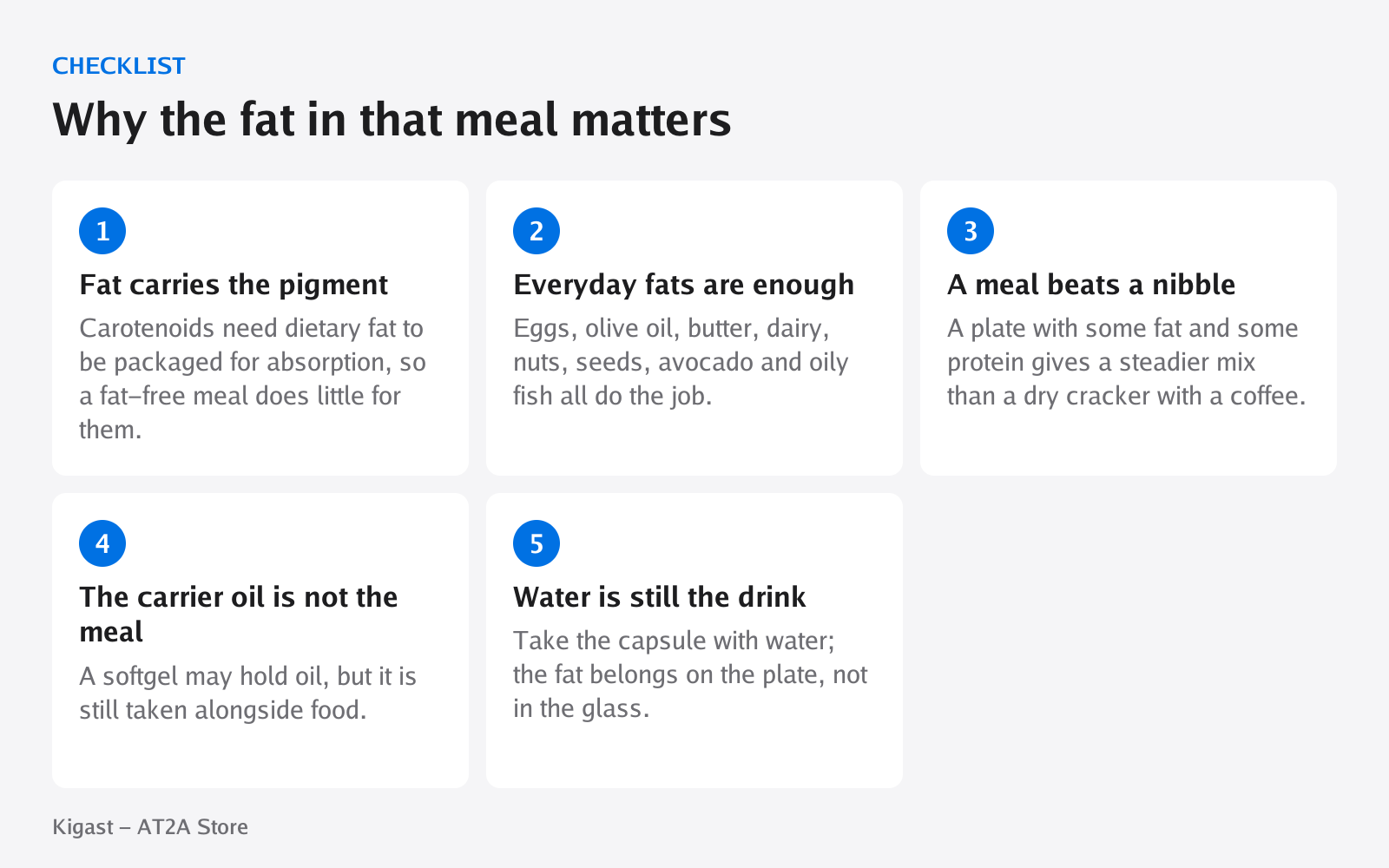
- Fat carries the pigment: carotenoids need dietary fat to be packaged for absorption, so a fat-free meal does little for them.
- Everyday fats are enough: eggs, olive oil, butter, dairy, nuts, seeds, avocado and oily fish all do the job.
- A meal beats a nibble: a plate with some fat and some protein gives a steadier mix than a dry cracker with a coffee.
- The carrier oil is not the meal: a softgel may hold oil, but it is still taken alongside food.
- Water is still the drink: take the capsule with water; the fat belongs on the plate, not in the glass.
How to fit astaxanthin into a daily routine
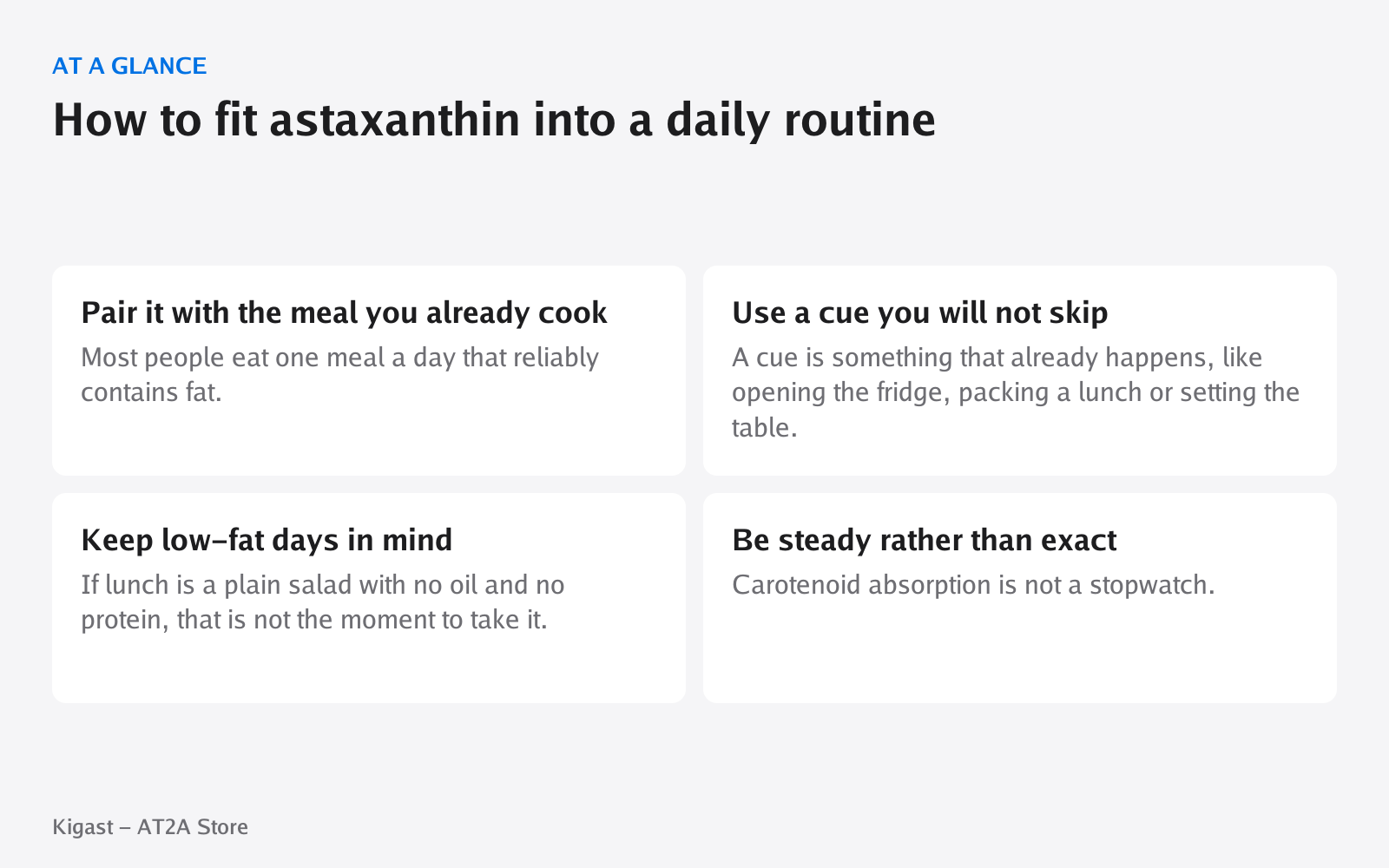
Pair it with the meal you already cook
Most people eat one meal a day that reliably contains fat. For some that is breakfast with eggs or yoghurt; for others it is lunch or dinner. Keep the bottle where you eat that meal, not where you sleep.
Use a cue you will not skip
A cue is something that already happens, like opening the fridge, packing a lunch or setting the table. Attach the capsule to that cue and it stops being a daily decision. A pill organiser works for the same reason.
Keep low-fat days in mind
If lunch is a plain salad with no oil and no protein, that is not the moment to take it. Move the capsule to a meal that has some oil, dairy or egg in it. The point is the pairing, not the clock.
Be steady rather than exact
Carotenoid absorption is not a stopwatch. Aim for the same meal each day and accept that timing drifts at weekends. A bottle finished over steady weeks is the goal.
How to read an astaxanthin label
Labels on astaxanthin products are short, but a few lines tell you how to take the product well.
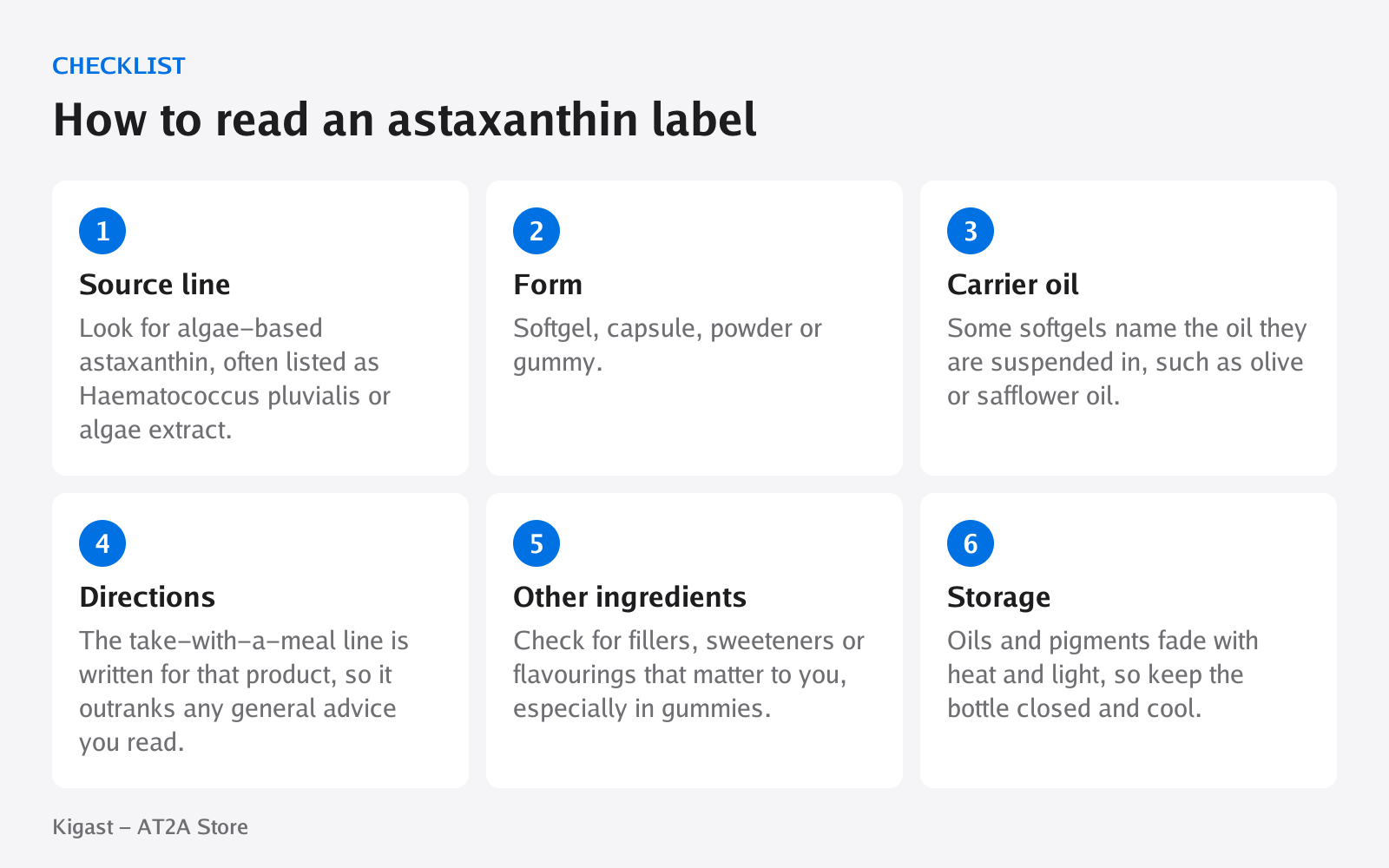
- Source line: look for algae-based astaxanthin, often listed as Haematococcus pluvialis or algae extract.
- Form: softgel, capsule, powder or gummy. Softgels usually carry an oil; powders are stirred into food or drink.
- Carrier oil: some softgels name the oil they are suspended in, such as olive or safflower oil.
- Directions: the take-with-a-meal line is written for that product, so it outranks any general advice you read.
- Other ingredients: check for fillers, sweeteners or flavourings that matter to you, especially in gummies.
- Storage: oils and pigments fade with heat and light, so keep the bottle closed and cool.
Who should check with a doctor first
Astaxanthin is sold as a supplement rather than a medicine, and most people simply take it with a meal. A few groups should ask before starting.
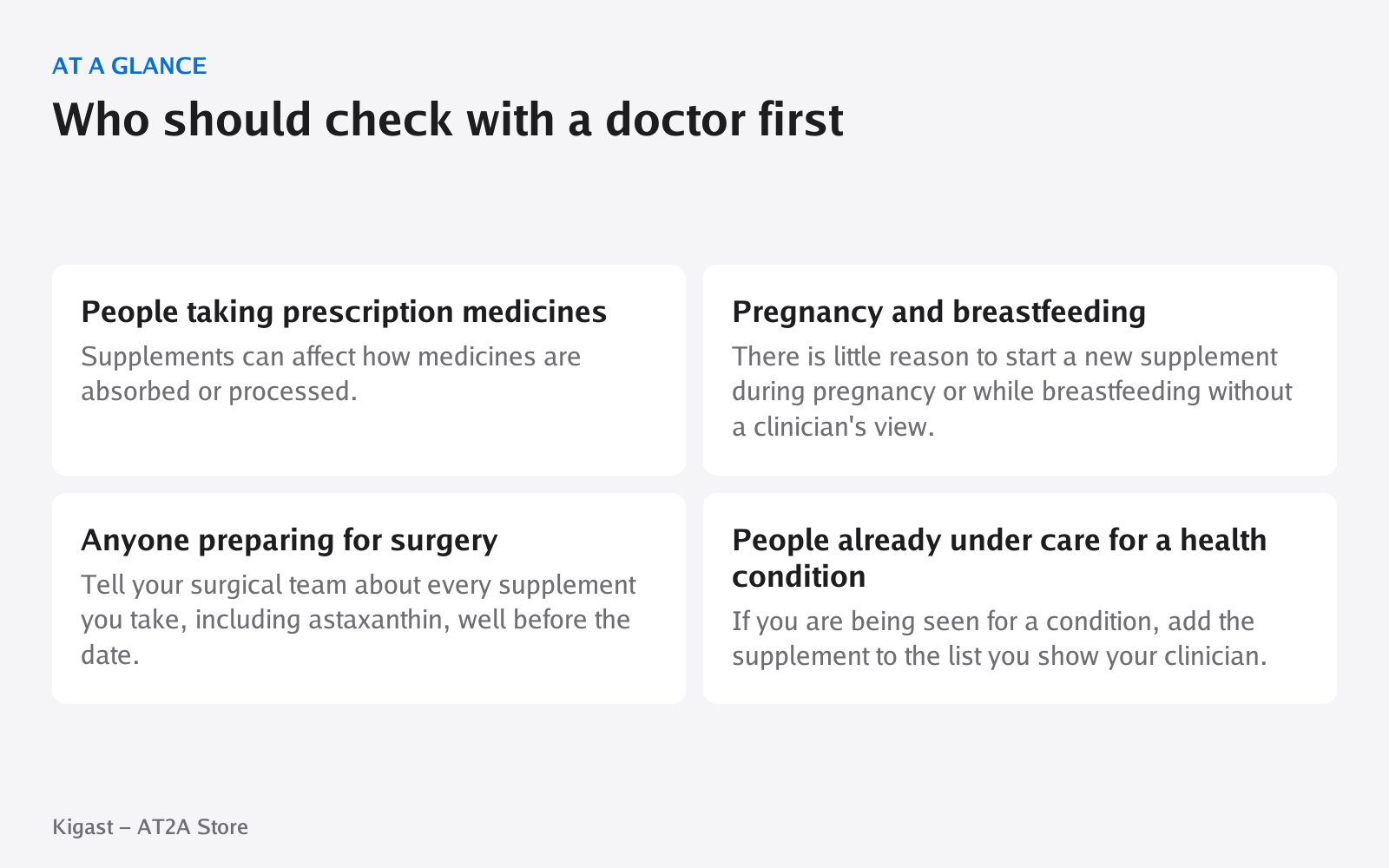
People taking prescription medicines
Supplements can affect how medicines are absorbed or processed. Bring the bottle to your pharmacist or doctor and ask about your own list rather than a general list from the internet.
Pregnancy and breastfeeding
There is little reason to start a new supplement during pregnancy or while breastfeeding without a clinician's view. Ask at an appointment rather than guessing from a label.
Anyone preparing for surgery
Tell your surgical team about every supplement you take, including astaxanthin, well before the date. They will tell you whether to pause it and when.
People already under care for a health condition
If you are being seen for a condition, add the supplement to the list you show your clinician. It is a short conversation that saves confusion later.
Adding astaxanthin alongside other supplements you already take
If you already take a daily gummy or capsule, the practical question is where astaxanthin fits, not whether you need more bottles. Two habits help. Keep each product's own directions line intact, and slot products that need food around meals you actually eat.
A few options from our shelves, described by their labels:
- ORANIC EXTRACT® 3-in-1 Wellness Gummies: combine shilajit, sea moss and ashwagandha plus lion's mane in one daily gummy, with 30 gummies per container. If you already take a gummy at breakfast, that meal is a natural place for it.
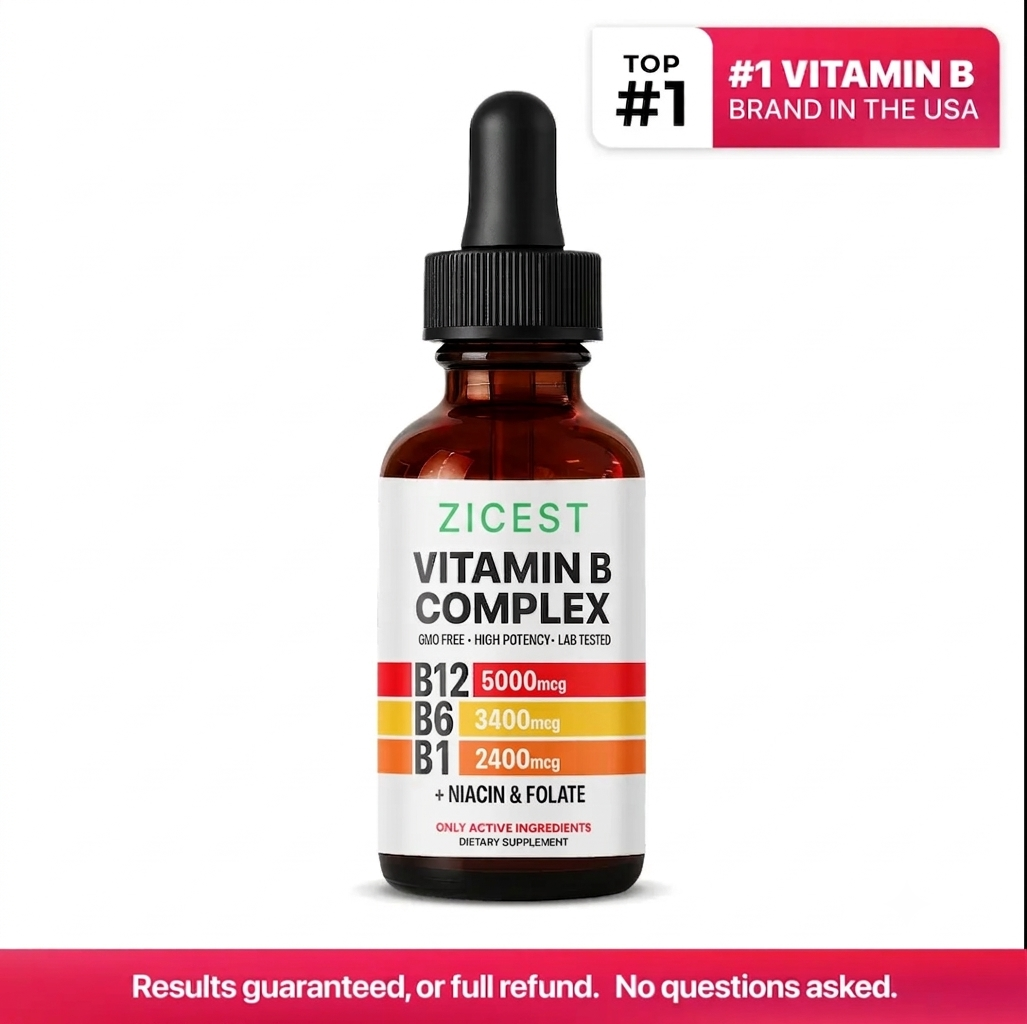
- 5-in-1 Vitamin B Complex: a liquid dropper supplement with vitamins B1, B3, B6, B9 and B12, and the label describes B vitamins as helping the body turn food into energy. Drops are easy to take at a meal.
- ORANIC EXTRACT® Pure Shilajit Gummies: 300 mg of shilajit per gummy, formulated to support everyday energy and vitality, with 30 gummies per container.
None of these products contains astaxanthin. They are simply other daily items that sit easily beside the meal habit described above. Read each label and keep the directions for each product separate.

Frequently asked questions
Can I take astaxanthin on an empty stomach?
You can, but you will absorb less. Carotenoids need fat in the same sitting to be packaged properly. If water is your only option that morning, take it anyway and plan the next one around a meal.
Does the fat have to come from a big meal?
No. A small amount of ordinary fat is enough: an egg, a spoon of olive oil, some yoghurt, a few nuts. The point is that fat is present, not that the plate is large.
What time of day is best for astaxanthin?
The meal you eat most reliably. Breakfast and lunch suit many people because those meals often carry fat and are easy to repeat. The clock matters less than the food on the plate.
Can I open the capsule or stir a powder into food?
Only if the label says so. Some powders are made to be stirred into yoghurt or a smoothie, which also supplies fat. Softgels should be swallowed whole unless the directions say otherwise.
What if I forget and take it without food?
Nothing dramatic. Note it, and take the next one with a meal. One capsule with water does not undo a steady routine.
Sources
- Vitamin A and Carotenoids - Health Professional Fact Sheet — Office of Dietary Supplements, NIH
- Vitamin E - Health Professional Fact Sheet — Office of Dietary Supplements, NIH
- Dietary Supplements: What You Need to Know - Consumer — Office of Dietary Supplements, NIH
- Vitamin D - Consumer — Office of Dietary Supplements, NIH
A note on these statements
These statements have not been evaluated by the Food and Drug Administration. This product is not intended to diagnose, treat, cure, or prevent any disease. Talk to your doctor or pharmacist before starting a supplement, especially if you are pregnant, nursing, take medication or have a medical condition.